Hekate's Night and the Rites of the Threshold

By late November, the library windows go dark before the afternoon lectures are over. The lamps come on one by one along the reading tables. Outside, the bare branches scrape against the glass like fingers trying to remember a word. It is the right season to speak of Hekate. She is the goddess of the threshold and the crossroads, of torchlight and the restless dead. In recent years, many who study and honor her have set aside November 30 as Hekate's Night, sometimes called Hekate's Crossing. It is a night for standing at the edge of things and looking down every road at once.
Scholarly honesty requires a confession before we go further. No ancient source names November 30 as a festival of Hekate. The date is a modern devotion, and some contemporary calendars also mark a Night of Hekate on November 16. Yet the observance draws on practices that were genuinely ancient. Those practices are recorded in poetry, in household custom, and in the grumbling of philosophers who disapproved of them. The date is new, but the rites are old. As any student of antiquity learns, this is often how the past survives: in borrowed clothes, on another evening, kept by hands that never knew the originals.
Rise of Hekate
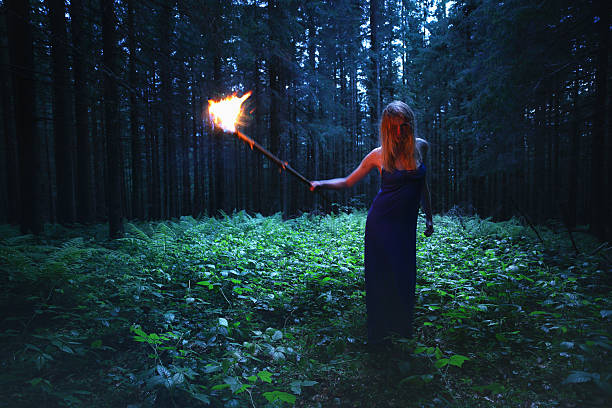
The earliest substantial portrait of Hekate comes from Hesiod's Theogony, composed around 700 BCE. There she is a goddess of startling breadth. Zeus honors her above nearly all others and grants her a share in earth, sea, and starry heaven. Hesiod's devotion to her is so pronounced that scholars have long debated why. Some propose a local cult in his native Boeotia, others a family tradition. Whatever its cause, the passage preserves a Hekate far grander than the witch-goddess of later centuries. The darker Hekate came afterward. She gathered to herself the night, the moon, sorcery, and the uneasy company of ghosts.
In the Homeric Hymn to Demeter, she appears at the moment of loss. From her cave, she hears Persephone scream as the earth opens and the lord of the dead drags the girl below. When the grieving Demeter wanders in search of her daughter, Hekate meets her bearing a torch. After Persephone's return, Hekate becomes her attendant and companion. So, she is the one who witnesses, the one who carries light into the descent, the one who walks with the dead and comes back. Her twin torches became her emblem, along with the key that opens what was meant to stay shut and the black dogs whose howling announced her passage.
Guardian of the Home
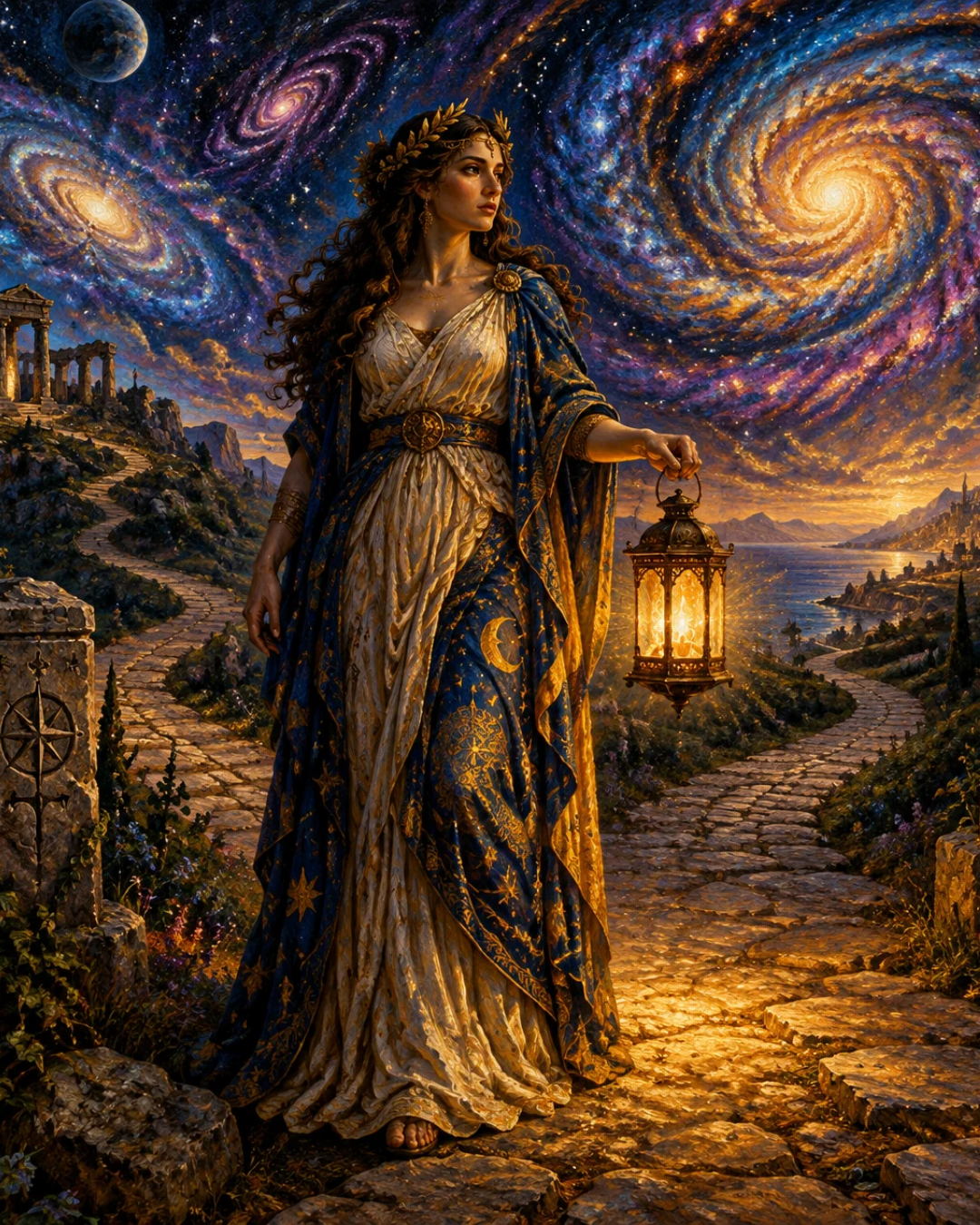
The Greeks called her Trivia, "of the three ways," and Enodia, "of the road." They set her image where paths divided, and sculptors gave her three faces or three bodies so she might watch every direction. More intimately, she guarded the doors of private houses. Many homes kept a small shrine at the entrance, a Hekataion, placing the goddess at the exact line where the household ended and the uncertain world began. To cross a threshold was to pass beneath her gaze. This was not superstition in the dismissive modern sense. It was an ordered understanding of space, in which every boundary was charged and every crossing carried risk.
The most famous of her rites was the deipnon, Hekate's Supper. At the dark of each moon, households purified their homes and carried the sweepings and the remnants of the month away. They set out a meal at the crossroads for the goddess and for the unquiet dead who traveled in her train. Ancient authors record offerings of bread, eggs, cheese, and small cakes. The supper served as both honor and cleansing, closing the month and expelling whatever pollution had gathered in the house. The comic playwright Aristophanes, and later the moralists, mocked the poor who crept out to eat the goddess's food. Even this cruelty preserves a truth. The offerings were real, they were placed, and in the dark, someone came to collect them.
Passing the Torch
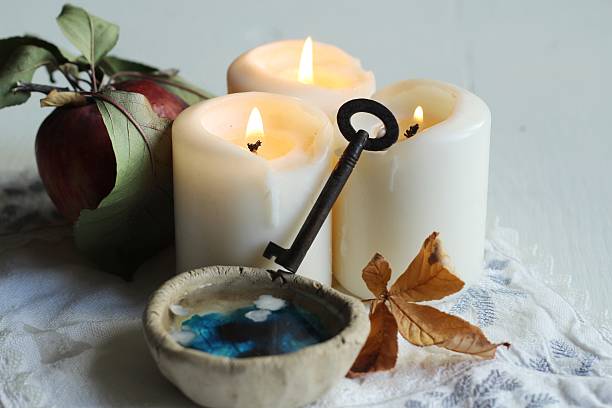
For those who wish to keep the night today, the old pattern still serves well. Cleanse the house, with special attention to the entrance, for the threshold was always her domain. Gather the household keys and lay them by the door beside a single flame. Prepare a plain supper in the ancient manner, perhaps bread, an egg, cheese, and something sweet, and set a portion apart. Rather than abandoning food at a public road, one may return it to the earth in a garden. Or one may honor the goddess's ancient bond with dogs through a gift to an animal shelter. Keep the candle on a stable, heatproof surface, away from drapery and books, and never leave it burning untended. A goddess of torches deserves a flame kept with discipline.
What lingers, after the candle is out and the keys are gathered, is the shape of the idea itself. Hekate presides over the moments when one thing ends, and another has not yet begun. These are the hinge of the door, the fork in the road, the hour between the last light and full dark. November is such a moment in the calendar of the year. The harvest is gone and winter has not yet fully come. To honor Hekate at this season is to admit that we, too, stand at crossroads. We must choose a path without knowing where it leads, and we carry what light we can.
So, on the last night of November, sweep the threshold and light the lamp. Set out the humble supper. Then stand a while at the window and look out at the dark where the roads divide. If a dog howls somewhere beyond the hedges, the old authors would tell you exactly who was passing.


Comments (0)
Login or Register to leave a comment.