The Fairy Coffins of Arthur’s Seat, Scotland

In the Edinburgh countryside lies a long extinct volcanic hill named Arthur’s Seat. Some claim it is the fabled seat of legendary King Arthur and the center of Camelot. But this blog is not about this famous king or his knights. This is about something far more perplexing. There, on this hill seventeen small coffins were discovered with carved wooden figures lying inside and labeled the fairy coffins.
The Discovery
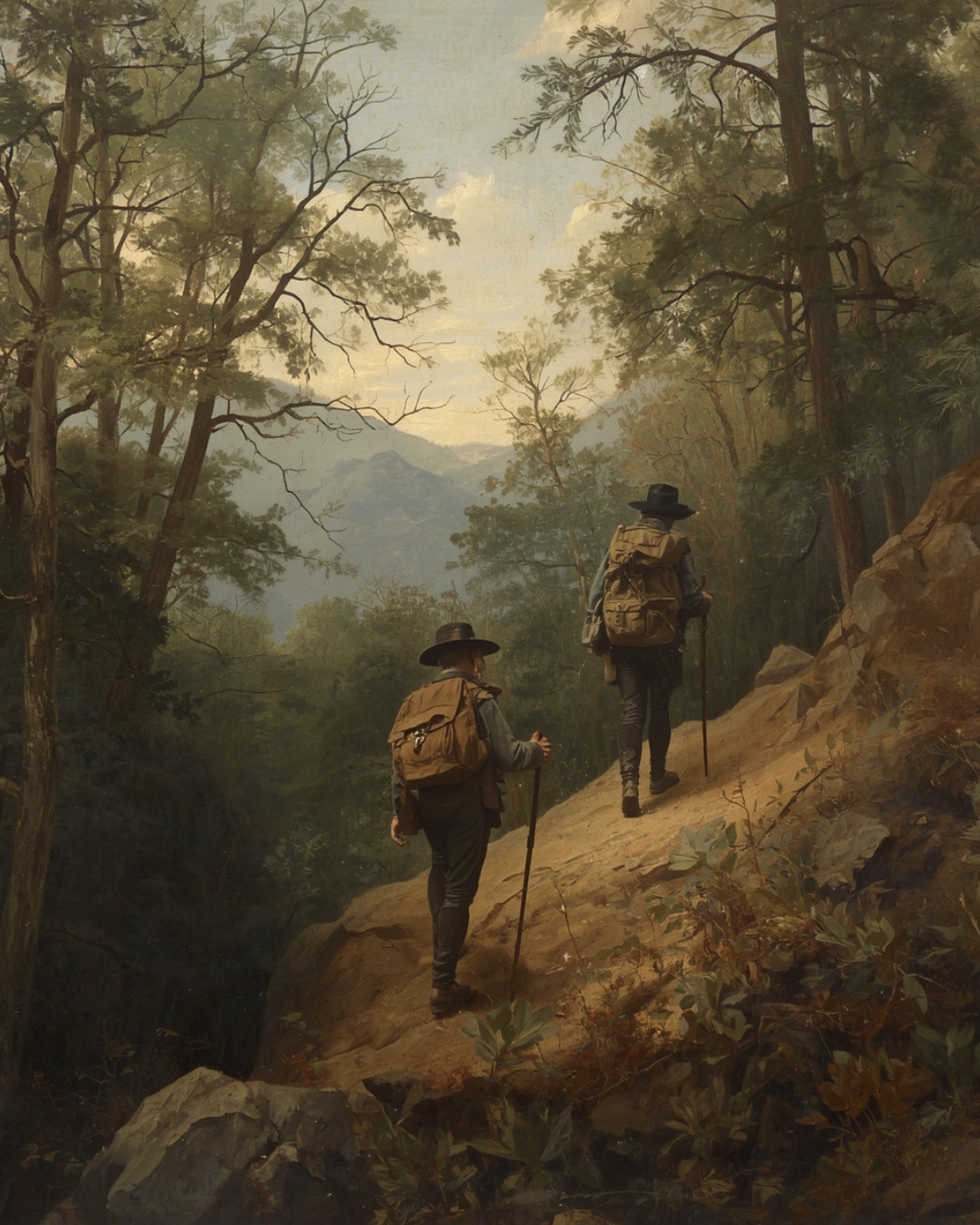
Behind Edinburgh’s Old Town rests Arthur’s Seat. It was home to the Celtic Vitadini tribe dating to 400 CE. But our story begins in the year 1836 when a group of boys went rabbit hunting on the hillside.
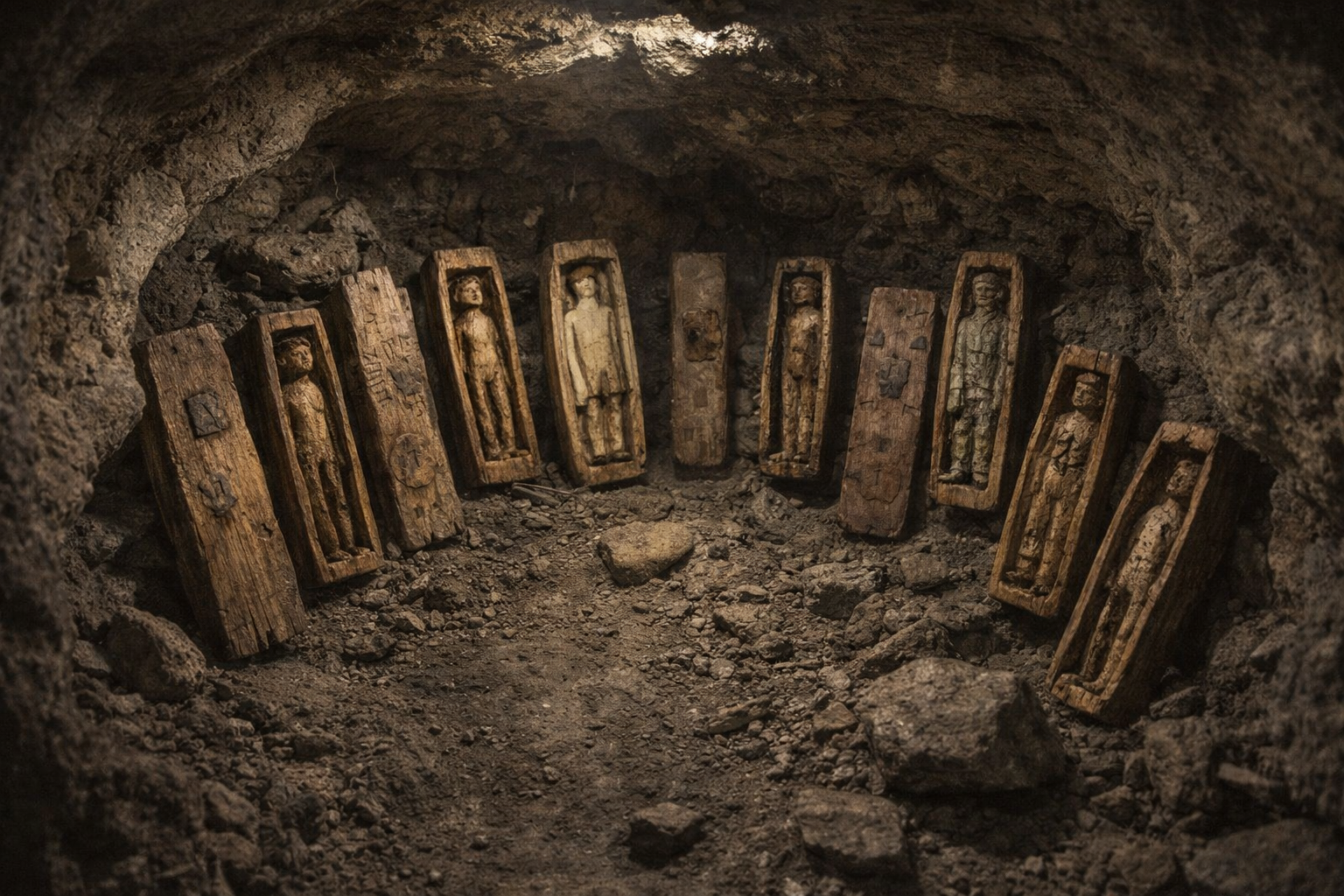
On a beautiful July morning three boys set out to hunt rabbits in Edinburgh. They began to search for burrows in the rocky formations of Arthur’s Seat. It was here that they discovered a small cave hidden behind some thin sheets of slate on the side of a cliff. It was there that they found seventeen small coffins, each only three to four inches long. The coffins were nestled on tiers of rock, like shelves, neatly laid out in rows of eight on two shelves. On a third, one coffin stood alone as if waiting for more. Inside the coffins rested small wooden figures dressed in assorted styles and material.
The Interred
As evidenced by the varied styles of clothing on the wooden figures, the coffins had been placed in the cave over a period of many years. On the first tier, the small coffins were in poor condition, being badly decayed. On the second, the coffins were in a better state. The lone coffin on the third tier appeared to be recent.
As rambunctious boys sometimes do, their actions destroyed several of the coffins when they threw them at each other. After their energetic and destructive play, the boys brought several of the coffins back down the hill into town. It was there that their schoolteacher and member of a local archaeological society, Mr. Ferguson, saw the coffins. He trekked into the hill the following day to carefully collect the remainder of the coffins and figures.
Media Frenzy
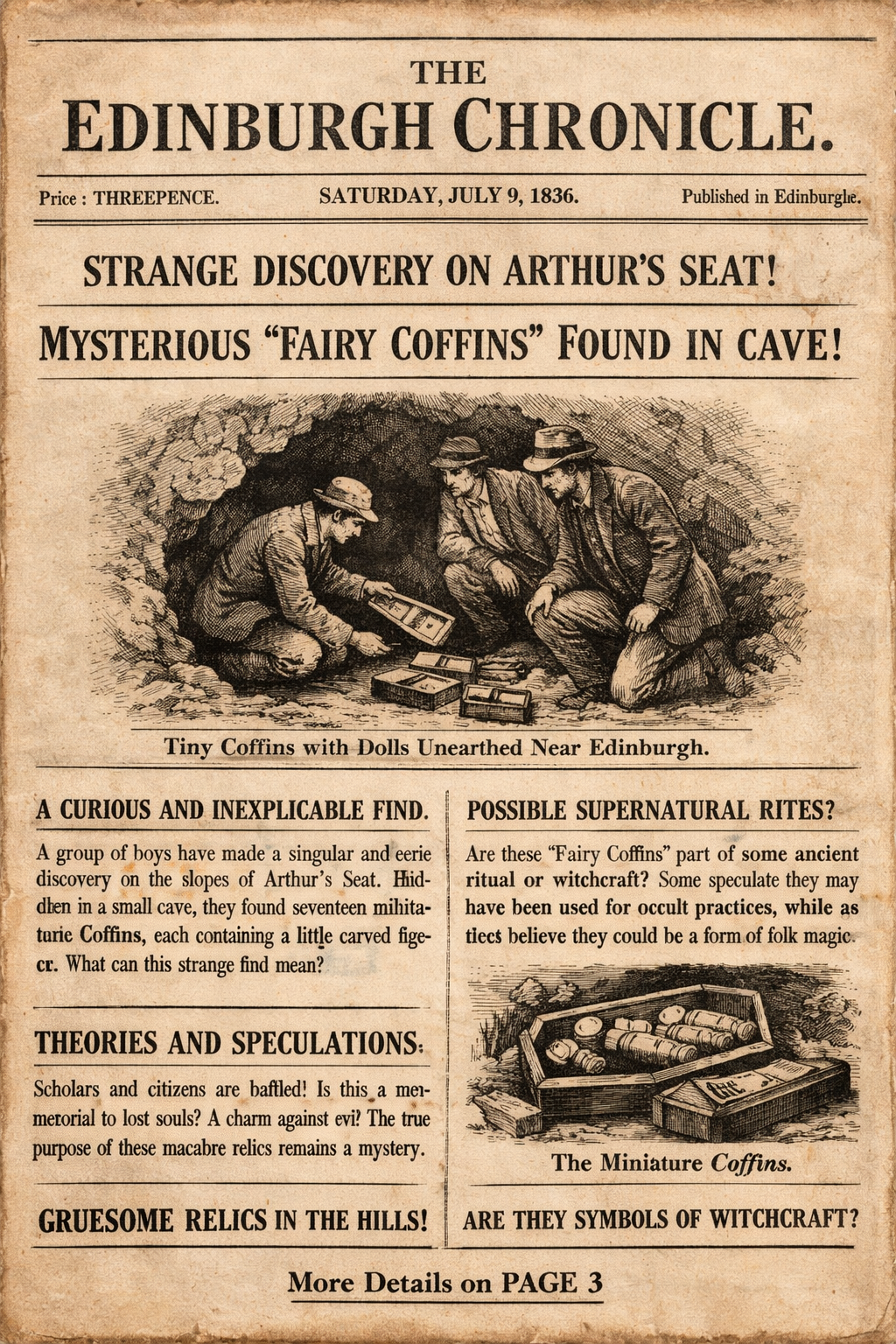
Mr. Ferguson, after a careful examination of all the artifacts, presented them to his archaeological group. Naturally, they were in awe and extremely excited about the discovery. Within three weeks the media began to report on the discovery and none of the stories mentioned the boys. It was not until much later that the boys were credited with the discovery.
Of course, the media had all sorts of theories regarding the coffins, and the public ate up every one of them! Everyone was quite excited and intrigued. Could they be a fairy burial? Maybe it was an evil spell factory used by witches! Perhaps, it was an ancient Saxon effigy custom, of effigies of sailors who had died at sea? But one of the most sensational theories was that they were related to the serial killers Burke and Hare!
Burke and Hare
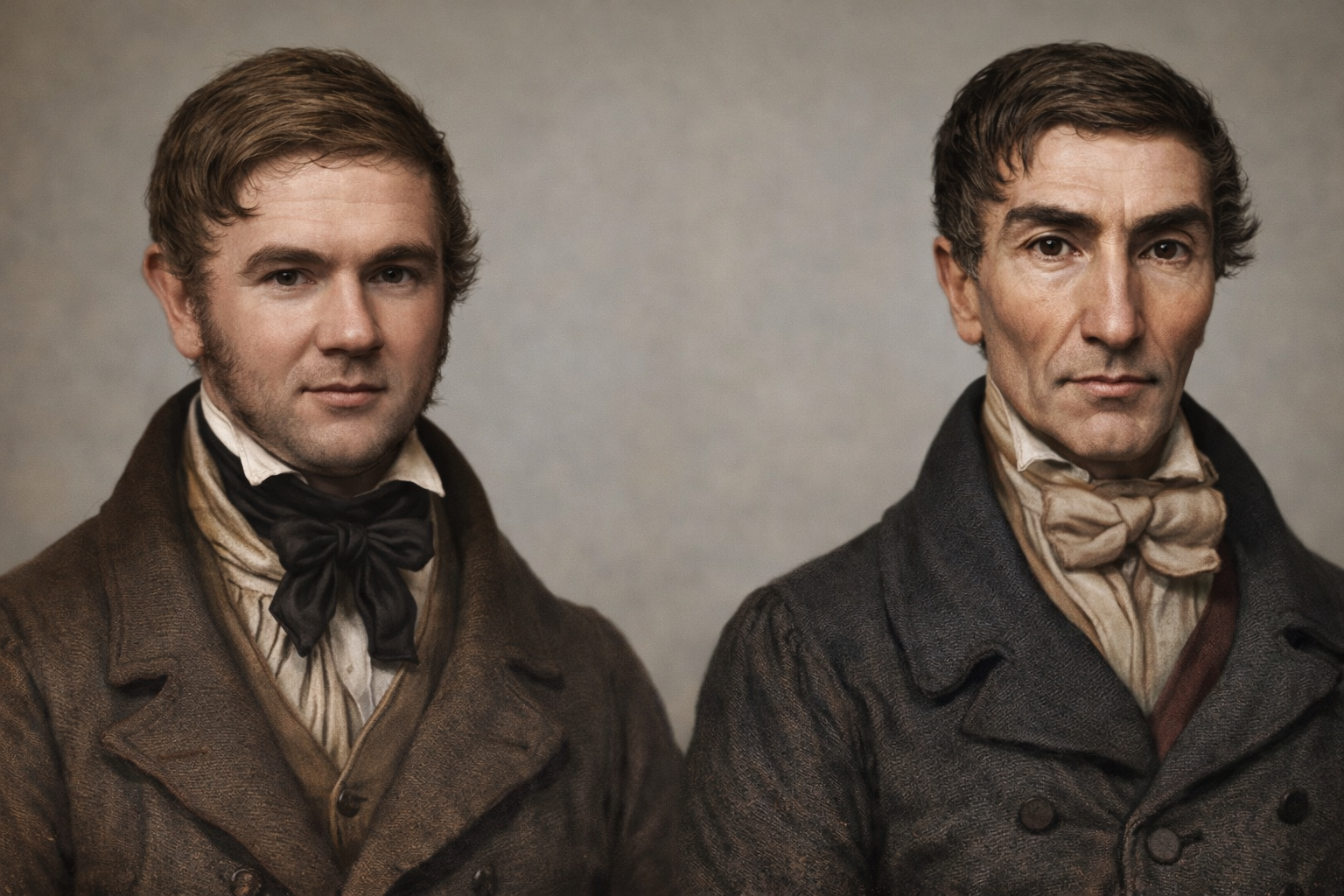
William Burke and William Hare were two serial killers active in Edinburgh a few years before the coffins were found. What tied them to the coffins in the public’s mind was that there were seventeen coffins, and the men had murdered seventeen victims.
During this time, cadavers were greatly needed for medical research, and some doctors were willing to pay handsomely for a body. Preferably one that was already deceased from natural causes, so to speak. But alas, things did not always go as planned.
Records reveal that in 1828, Burke and Hare murdered seventeen people and sold the bodies to Dr, Robert Knox for dissection and anatomy lessons. Mr. Hare testified against Mr. Burke to gain immunity. Mr. Burke was hanged and ironically, his remains were then used for anatomy lessons. His skeleton is still on display at the Edinburgh Medical School. No charges were brought against Dr. Knox; however, his reputation was destroyed and he left Edinburgh in disgrace.
Journey of the Coffins
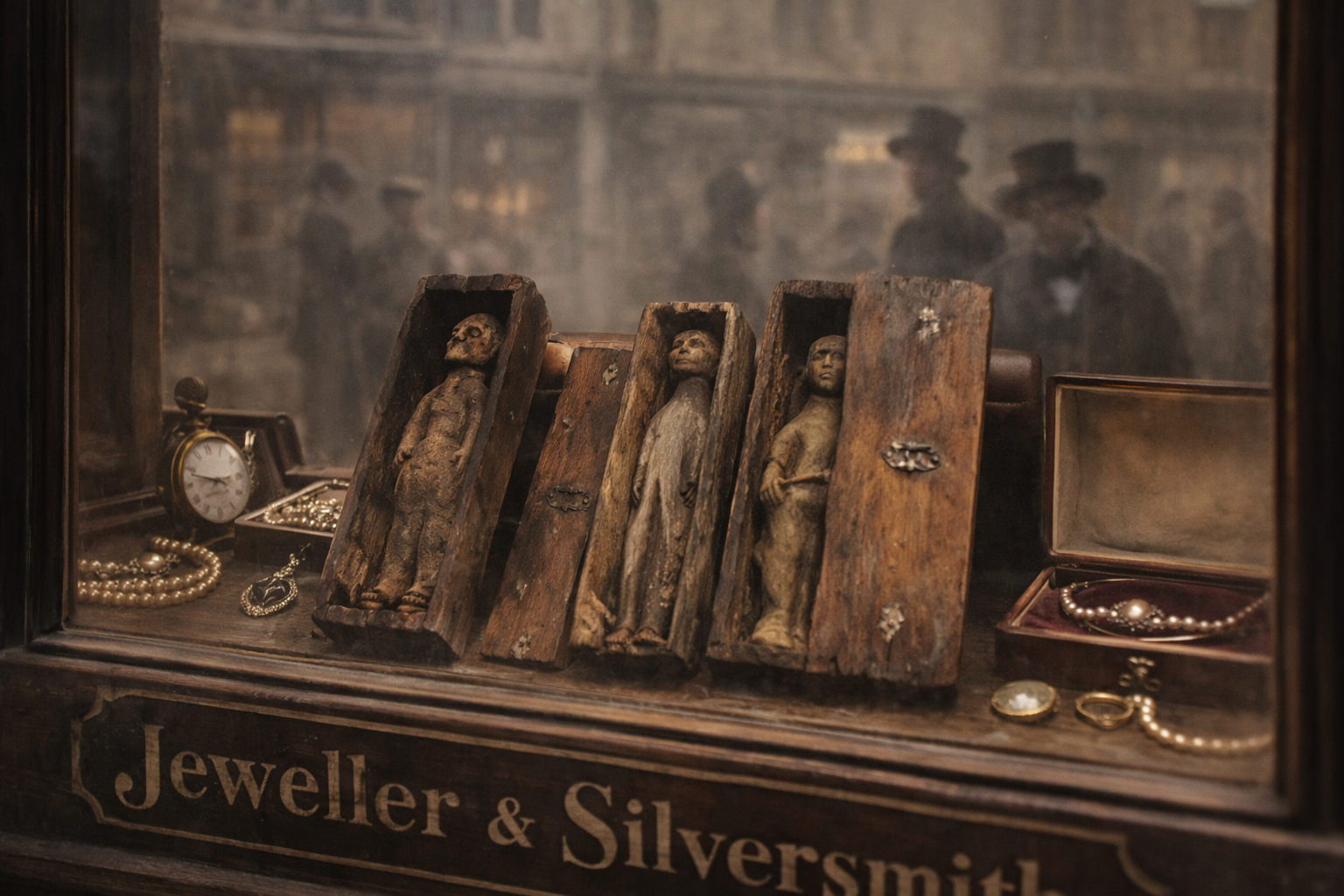
After Mr. Ferguson presented the discovery to his archaeology group, they found their way to a local jeweler on Princes Street who displayed them in his shop window. There, they drew large curious crowds. They later found their way to another jeweler, Robert Frazier, who ran a private museum on South Andrews Street. He displayed them for several years in his museum.
After Mr. Frazier’s death, his belongings were auctioned off. It was during this time the lot of “Lilliputian Coffins” was auctioned off for four pounds. Over the next fifty years, the coffins passed between various private collectors. In 1901, Christina Couper donated the eight surviving coffins to the Museum of the Society of Antiquaries of Scotland. Presently, they reside in the National Museum of Scotland where they remain a popular exhibit.
Scientific Findings
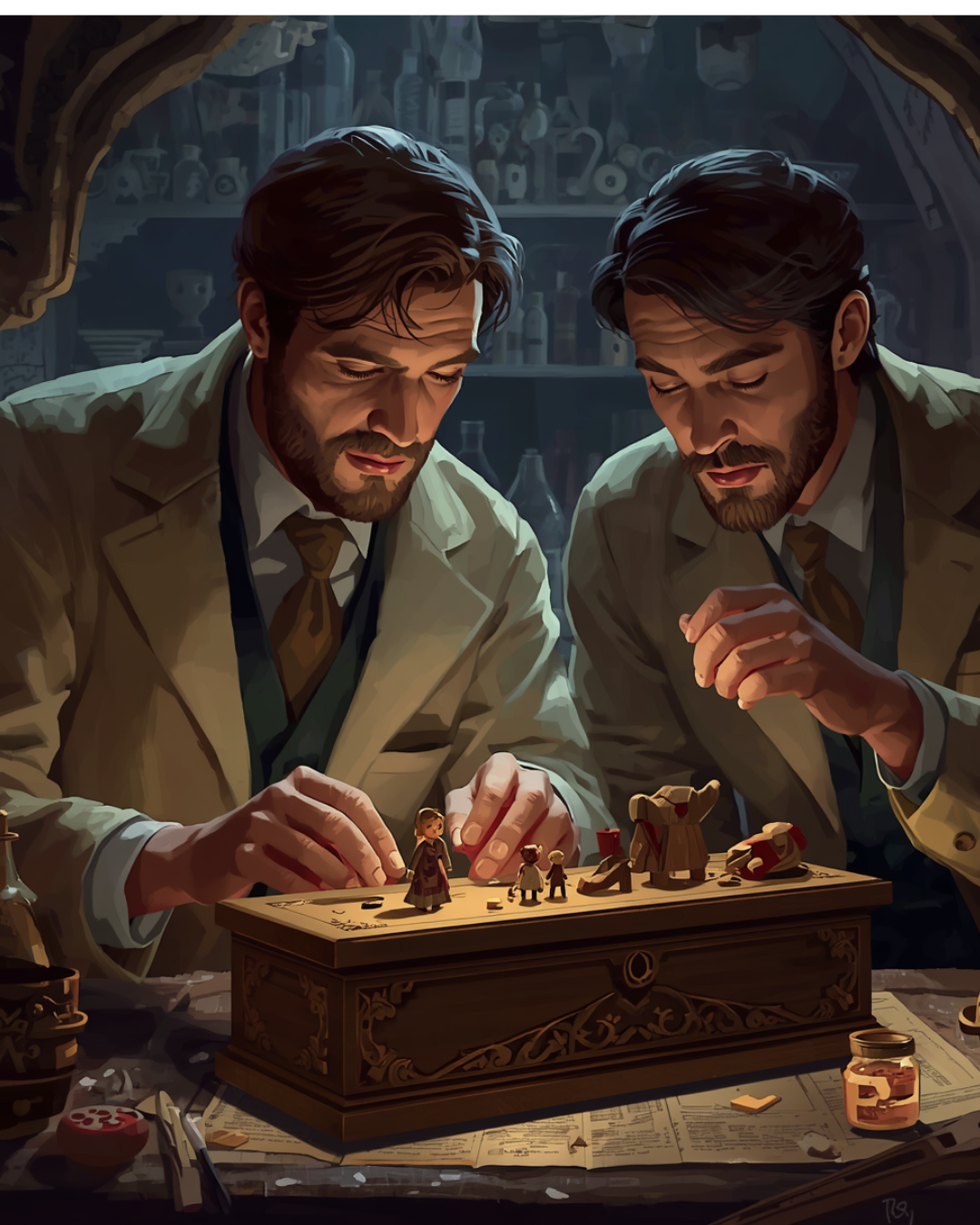
In 1994, Professor Samuel Menefee and Dr. Allen Simpson performed the most thorough scientific study of the surviving "fairy coffins." Their findings transformed the mystery from a purely supernatural tale into one of forensic detective work.
The analysis focused on the construction, tools, and materials used, revealing several critical details.
The researchers found that the coffins and figures were crafted with a sharp, hooked knife, like a cobbler’s knife. The metal ornaments on the lids were made of tinned iron, like the tin used in shoe buckles at the time. The figures were carved from soft pine, and their clothing was made of cotton fabric that was common in the early 1830s. Some of the fabric used for the outfits was found to match old household linens or even pieces of old umbrellas.
Simpson and Menefee found that the figures were not originally carved to be "corpses." They had open eyes and rigid bearings with flat feet. They were likely a set of mass-produced toy soldiers from the 1790s that were later "re-dressed" and repurposed for burial. While the figures all appear to have been adapted by the same person, the coffins showed signs of being created by at least two different people.
The most important result of the 1990s study was narrowing down the burial date. Because the fabric and the specific type of thread used only became available around 1830, the researchers concluded the coffins could have been buried for more than six years before the boys found them in 1836. This period is key because it aligns almost perfectly with the immediate aftermath of the Burke and Hare murders (1828), lending strong scientific weight to the theory that they were a symbolic memorial for the seventeen victims.
A Modern Twist
In December 2014, the National Museum of Scotland received a mysterious package with no return address that added a modern layer to the nearly 200-year-old puzzle.
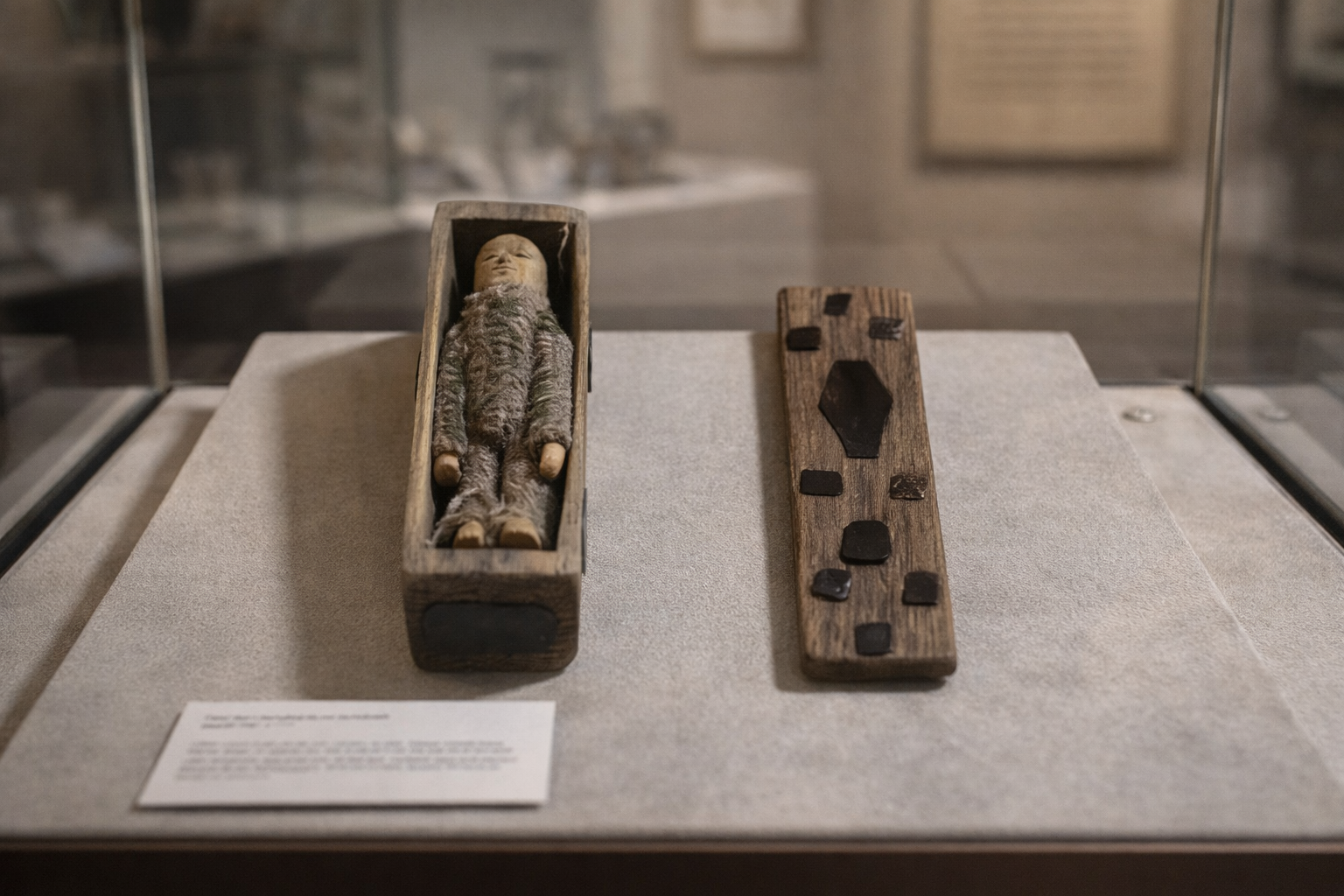
Inside the box was a beautifully made replica of one of the original fairy coffins. It was created with such mindfulness that it included metal ornaments on the lid and a roughly carved wooden figure inside.
The package included several cryptic elements. A handwritten note was attached to the replica marked with the Roman numerals for 18 (XVIII). This is widely interpreted as a nod to it being the "18th coffin," following the original set of seventeen found on Arthur's Seat. The label featured a chilling extract from the climax of Robert Louis Stevenson's 1884 short story, The Body Snatcher. The story itself was inspired by the real-life crimes of Burke and Hare, further cementing the link between the coffins and the serial killers. The note described the replica as a "gift" and thanked the museum staff for "caring for our nation's treasures, especially the VIII" (referring to the eight original surviving coffins).
While the sender remains anonymous, the gift is seen by the museum as a testament to the enduring grip the "fairy coffins" have on the public's imagination. It highlights how the artifacts have evolved from mere curiosities into deep-rooted pieces of Scottish folklore and literary history.


Comments (0)
Login or Register to leave a comment.